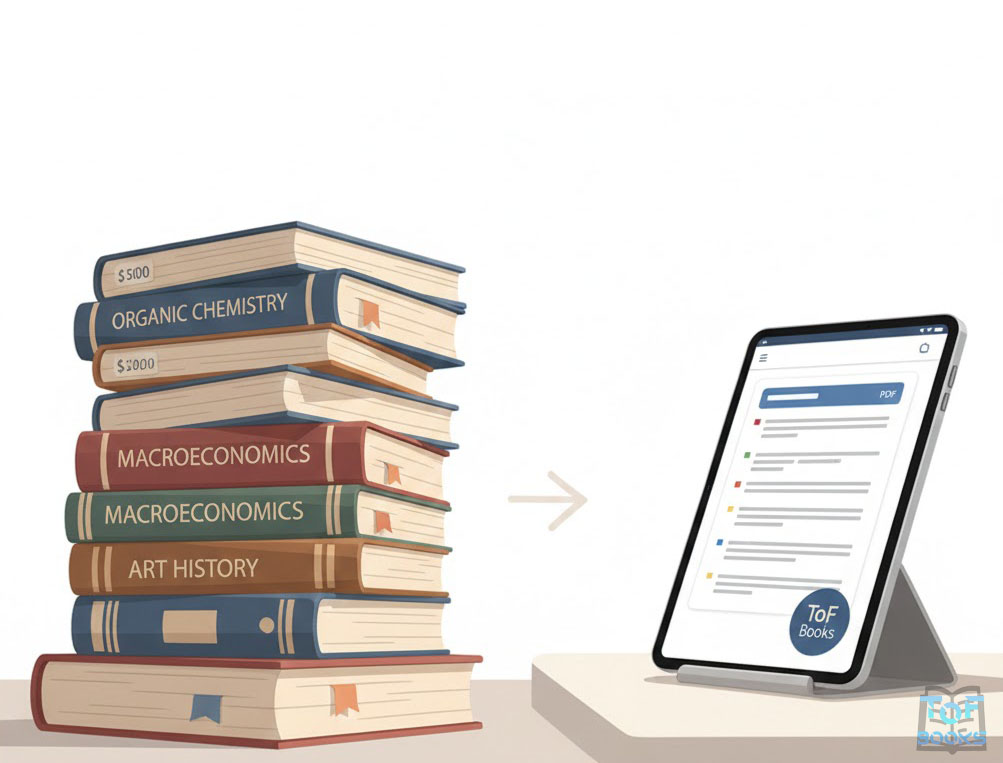
The modern college experience is increasingly defined by the rising cost of academic resources. For many students, the excitement of starting a new semester is quickly overshadowed by the “sticker shock” of the campus bookstore, where a single organic chemistry or macroeconomics volume can easily exceed $300. In this environment, learning how to find PDF of textbooks is more than just a convenience; it is a vital survival skill for managing a student budget.
However, the quest for digital textbooks can be a minefield of broken links, invasive malware, and ethical dilemmas. This guide provides a comprehensive roadmap for securing your course materials safely, legally, and efficiently.
Why Choose Digital Over Print?
Before we dive into the search methods, it’s worth noting why digital formats like PDF and ePub have become the gold standard for higher education:
- Hyper-Portability: You can carry 20kg of textbooks on a 500g tablet.
- Financial Savings: Digital editions are almost always a fraction of the price of physical hardcovers.
- Enhanced Study Tools: With digital files, you can use
Cmd+ForCtrl+Fto find specific keywords instantly, rather than flipping through an index for 15 minutes. - Eco-Friendly: Switching to digital helps reduce the massive carbon footprint associated with paper production and shipping.
1. ToF Books: The Hub for Legal, High-Quality Textbooks
While the internet is full of “shadow libraries,” many of them operate in a legal gray area or host poor-quality scans that are difficult to read. ToF Books stands out as a premier resource because it bridges the gap between affordability and legality.
Every book on the ToF Books platform is a high-resolution PDF or ePub file provided with the 100% permission of publishers or authors. This means:
Searchable Text: Unlike a photographed scan, these are “born digital” files where every word is searchable and selectable.
Ethical Sourcing: You are supporting the creators and publishers while still saving up to 80-90% compared to bookstore prices.
Safe Downloads: You don’t have to worry about the “Download” button leading to a virus; the site is a secure, curated marketplace.
Check out the latest arrivals in the ToF Books Shop to see if your required reading is already available at a deep discount. If you don’t find the ebook you are looking for, just request and email us and we’ll arrange it for you!
2. Leveraging the Power of Reddit Communities
If you aren’t sure where to start your search, Reddit is home to some of the most helpful student-run communities on the web. Specifically, the subreddit r/textbook (and its sister subs like r/textbooks) is a goldmine of information.
Navigating r/textbook
When you visit the r/textbook subreddit, pay close attention to the “Sticky Posts” (the posts pinned at the very top).
The Megathread: Usually, the first or second sticky post is a Megathread or a Wiki link. These contain exhaustive lists of verified sites, search engines, and sellers who have been vetted by the community.
The Wiki: The r/textbook Wiki is a living document that tracks which sites are currently active and which have been seized or shut down. In a digital landscape that changes monthly, this real-time update is invaluable.
User Requests: You can often find threads where users share their experiences with specific titles. Always look for “Trusted” flair or high-karma users when taking advice on where to buy or download.
3. Mastering Advanced Google Search Operators
Many textbooks are actually hosted on university servers or public repositories, but they are buried under layers of search results. You can use “Google Dorks” to bring these files to the surface. Check out this special custom search engine made only for searching free or cheap PDF textbooks!
To find a specific textbook, use the following syntax:
filetype:pdf "Title of Your Book" "Author Name"
For example, if you are looking for a biology book, you might type:
filetype:pdf "Campbell Biology" "Urry"
By adding -inurl:htm -inurl:html -inurl:php, you can exclude standard web pages and force Google to only show you direct links to PDF documents.
Warning: Use this method with a high-quality antivirus and adblock enabled, as some results may lead to untrusted domains.
4. Open Educational Resources (OER): The “Free” Gold Standard
The OER movement is a global initiative to provide high-quality, peer-reviewed textbooks for free. These are legally open-licensed for anyone to use.
OpenStax (Rice University): Best for introductory courses like Physics, Calculus, and Psychology.
LibreTexts: A massive, multi-institutional project that covers everything from Chemistry to Humanities.
Open Textbook Library: Hosted by the University of Minnesota, this library allows you to read reviews from other professors before you download.
5. PDF vs. ePub: Which Format is Better for You?
When you find your textbook on a site like ToF Books, you may have the choice between formats. Understanding the technical difference is key to a better study experience:
PDF (Portable Document Format)
Fixed Layout: The page looks exactly like the physical book. This is crucial for subjects like Mathematics or Engineering, where the placement of diagrams and formulas matters.
Printing: If you prefer to print out specific chapters, PDF is the best format.
Annotation: Excellent for “writing” in the margins using a stylus on a tablet.
ePub (Electronic Publication)
Reflowable Text: The text size adjusts to fit your screen. If you are reading on a smartphone or a small e-reader (like a Kindle), ePub is vastly superior because you won’t have to “pinch and zoom” to read a sentence.
Customization: You can change the font, background color (e.g., Sepia or Dark Mode), and line spacing to reduce eye strain.
- Paging: Page number’s usually don’t match the printed book

6. Utilizing Your University Library’s Digital Access
Before spending a dime, check your library’s portal. Many universities pay millions of dollars annually for subscriptions to digital repositories.
Log into your library’s website.
Search by ISBN rather than just the title (no dashes. ISBN 13 is best).
Look for “Full Text Online” or “E-Book” links.
Platforms like ProQuest Ebook Central or EBSCOhost often allow you to download the entire book as a PDF for a 14-day “borrowing” period, or download specific chapters permanently. Pro Hint: That’s how most sellers rip and get you cheap textbooks 😉
Summary Table: Where to Find Your Textbooks
| Resource Type | Best For | Legality |
| ToF Books | Specific, high-quality course titles | 100% Legal & Authorized |
| OpenStax | Intro-level STEM & Social Sciences | Free & Open Source |
| r/textbook Wiki | Finding the latest active links & community advice | Community Vetted |
| Project Gutenberg | Literature, History, & Philosophy (Classics) | Public Domain |
| University Library | Academic monographs & expensive journals | Included in Tuition |
The Ethical and Secure Path
Finding a PDF of a textbook doesn’t have to involve clicking through shady pop-ups. By starting with legal repositories like ToF Books and utilizing the community knowledge in r/textbook, you can navigate your college years with a lighter backpack and a much heavier wallet.
Always prioritize “born-digital” files over scanned images. Not only is the text clearer, but the ability to search and highlight will save you hundreds of hours of study time over the course of your degree.